
Choosing between local SEO vs national SEO comes down to a few important questions: Where does your business operate? Who are you trying to reach? And how are your products or services delivered?
A company serving customers within a defined geographic area needs a different approach from a business targeting customers across multiple states or nationwide.
The goal isn’t simply to reach the largest possible audience. A successful SEO strategy should focus on reaching the right audience by aligning your website with your services, customers, geographic markets, competition, and growth goals.
So, should your business focus on local SEO, national SEO, or a combination of both? Let’s break down the differences.
What Is the Difference Between Local SEO and National SEO?
Local SEO focuses on improving search visibility within a specific geographic area. It is especially important for businesses that serve customers in particular cities, communities, or service areas.
National SEO takes a broader approach. Instead of concentrating primarily on searches tied to one location, it targets customers across a larger regional or nationwide market.
The biggest difference is the geographic scope of the audience you’re trying to reach.
| Factor | Local SEO | National SEO |
| Geographic focus | Specific cities, communities, or service areas | Broader regional or nationwide audience |
| Main audience | Customers looking for services in a particular area | Customers searching for services regardless of a specific local area |
| Content focus | Geographic relevance and location-specific information | Broader service and topic relevance |
| Business profiles | Particularly important for local visibility | Typically less dependent on geographic signals |
| Search visibility | Relevant local searches | Broader search visibility |
| Content opportunities | Location and community-focused pages | Service, topic, and broader market content |
| Best suited for | Businesses serving defined areas | Businesses serving wider markets |
Neither approach is automatically better. The right choice depends on how your business actually operates and where your customers are located.
When Does Local SEO Make More Sense?
Local SEO makes sense when customers are concentrated within a particular geographic area.
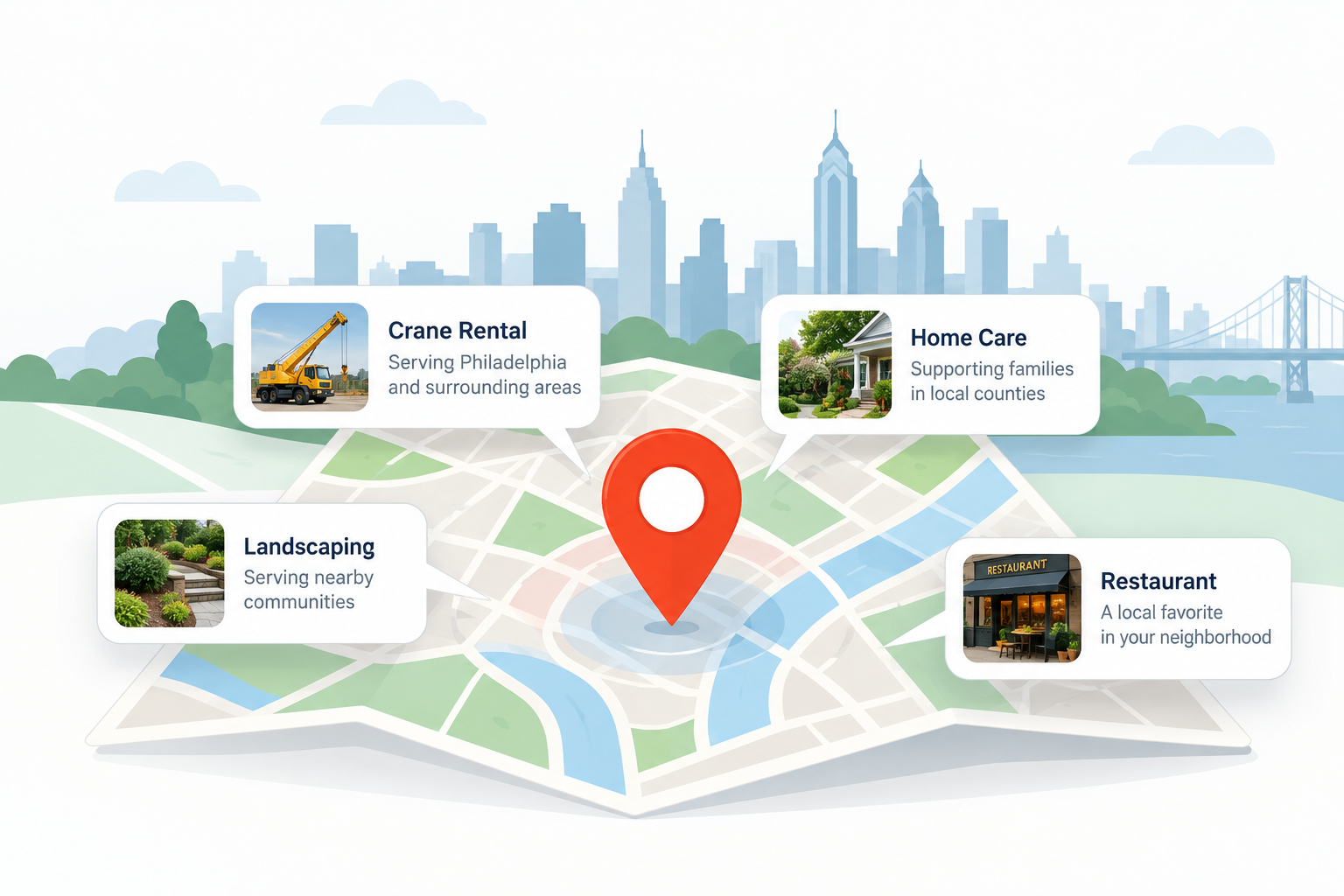
Think about a crane rental company serving Philadelphia and the surrounding region, a home care provider working within specific counties, a landscaping company serving several nearby communities, or a restaurant trying to reach customers in its immediate area.
In each case, location plays an important role in how customers search for and choose a provider.
Local SEO may be the right approach when:
- Your business serves customers in defined geographic areas.
- Customers need to find a provider near them.
- Location is an important part of your service.
- You compete with other providers within the same market.
- Your website needs to clearly communicate where services are available.
- Google Business Profiles and local search results play a role in customer discovery.
Effective geographic SEO targeting goes beyond adding city names to a page. Your website should genuinely demonstrate where you operate and provide useful information for customers in those markets.
The Role of Geographic Content in Local SEO
Geographic content helps search engines and potential customers understand where your business operates and which markets you serve.
Depending on the business, useful geographic content can explain:
- Which services are available in a particular area
- Which cities, communities, or regions you serve
- Information that is particularly relevant to customers in that market
- Where your business or individual locations operate
- How your services apply to customers in the target area
The key word here is useful.
Creating dozens of nearly identical pages and swapping out the city name doesn’t provide the same value as creating location content that genuinely addresses the needs of customers in that market.
Before adding new geographic pages, review your existing website. Determine whether your most important services and locations are clearly represented and where meaningful content gaps exist.
Why Google Business Profile Matters for Local Search
Your website is only one part of local search visibility.
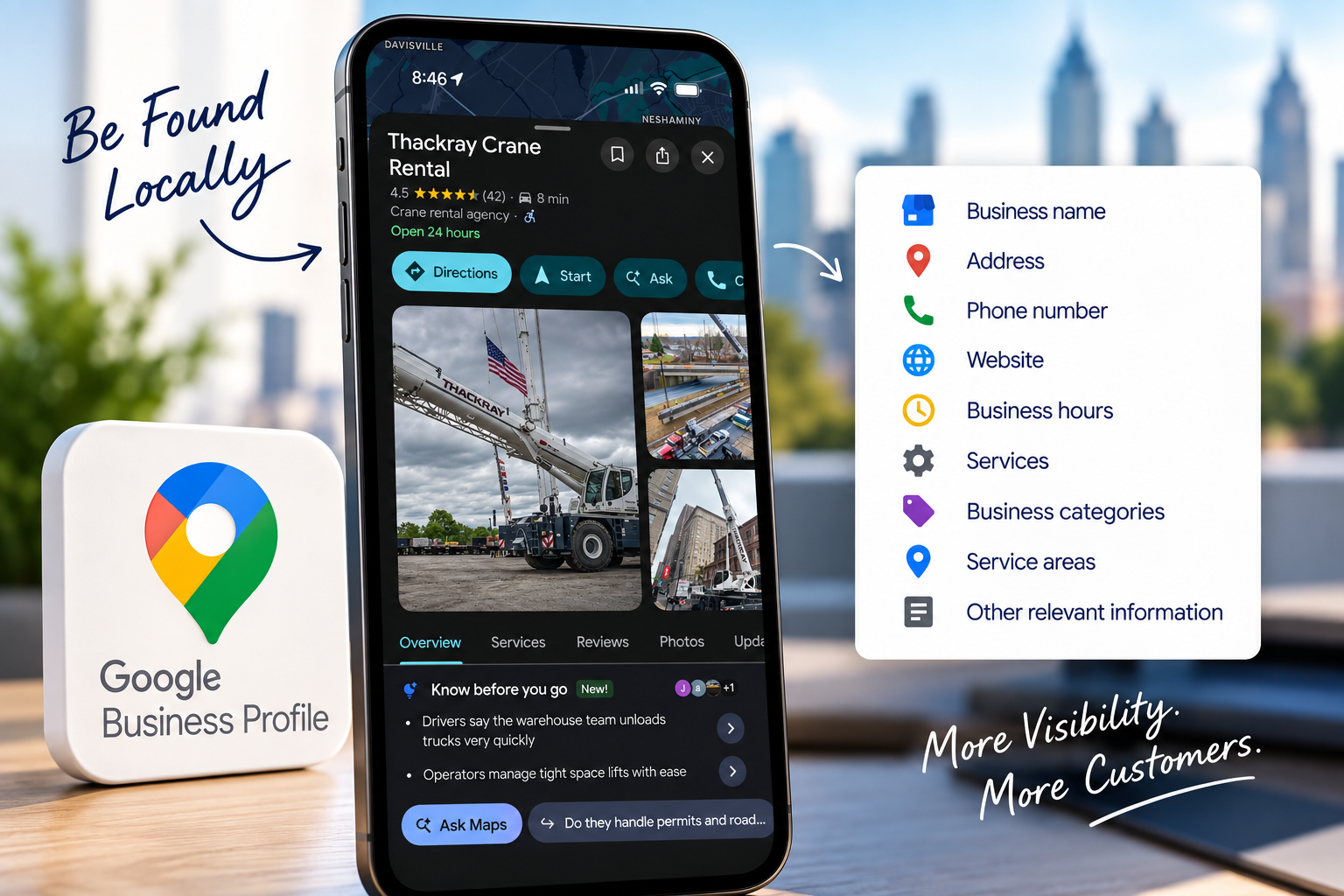
A Google Business Profile can help your business appear when customers search for nearby products and services, including within Google Maps and local search results.
That’s why Google Business Profile optimization should be an important part of a local SEO strategy.
Make sure your profile accurately communicates information such as:
- Business name
- Address
- Phone number
- Website
- Business hours
- Services
- Business categories
- Service areas
- Other relevant business information
Your business information should also be accurate and consistent across the web.
A Google Business Profile doesn’t replace your website. The two should work together. Your profile can help customers discover your business locally, while your website gives them the detailed information they need to understand your services, evaluate your company, and take the next step.
What Is National SEO?
National SEO focuses on reaching a broader geographic audience rather than concentrating primarily on one city or local market.
This approach can make sense for businesses that serve customers across multiple states, throughout the country, or anywhere their products and services can be delivered.
National SEO may be appropriate when:
- Customers are located across multiple markets.
- Your services are not dependent on a customer’s physical proximity.
- You want to expand your geographic reach.
- Your website needs to compete for broader search terms.
- Your products or services can be delivered across a wide area.
Going national doesn’t mean geographic relevance disappears completely. It means the primary SEO focus shifts toward broader service, product, industry, and topic-based searches.
National SEO Requires Broader Keyword and Content Planning
Keyword research is an important part of any SEO strategy because it helps identify how potential customers search for the products and services a business provides.
With national SEO, keyword research typically expands beyond location-specific phrases and into broader service and topic opportunities.
Those keywords can then be mapped to existing pages or used to identify areas where additional website content may be valuable.
A national SEO strategy may require greater attention to:
- Core product or service pages
- Supporting topic pages
- Relevant search phrases
- Existing website content
- Content gaps
- Internal website structure
- Links between related pages
- Content authority and depth
The goal isn’t to fit as many keywords onto a page as possible. It’s to create a website that thoroughly and clearly addresses the topics your potential customers are searching for.
Local SEO vs National SEO: Which One Should You Choose?
The decision should start with your business model and your customers.
| Business Situation | More Suitable Approach |
| Primarily serves one city or defined community | Local SEO |
| Serves several nearby communities | Local SEO with broader geographic targeting |
| Depends on customers finding a nearby provider | Local SEO |
| Provides services across a wide geographic area | National SEO |
| Wants to expand beyond its current local market | Combination of local and national SEO |
| Has both local and nationwide customer segments | Combination approach |
| Operates physical locations across multiple markets | Multi-location SEO |
Your SEO strategy doesn’t have to fit permanently into one category.
A company may begin by concentrating on its existing local market and expand into additional regions over time. Another may have some services that are highly local while offering others nationwide.
Your website and SEO strategy can evolve along with the business.
What About Multi-Location SEO?
Some businesses fall somewhere between traditional local and national SEO.
If your company has offices, stores, service centers, franchises, or other physical locations across multiple markets, multi-location SEO can help each location establish its own local search presence while remaining part of a larger brand.
This may involve dedicated location pages, individual Google Business Profiles where eligible, locally relevant content, consistent business information, and a website structure that makes each location easy for users and search engines to understand.
The goal isn’t to create hundreds of duplicate location pages. Each important location should have a clear purpose and enough useful information to serve customers in that particular market.
For businesses with a growing geographic footprint, a multi-location strategy can combine elements of local and broader SEO rather than forcing the entire company into one approach.
Competition Also Affects the Decision
Competition is another important factor when choosing between local SEO and national SEO.
With local SEO, you may be competing against a smaller number of businesses, but those companies are often targeting the exact same customers in the same geographic market. Geographic relevance, Google Business Profiles, local content, reviews, links, and strong service pages can all become important differentiators.
National SEO can mean competing against companies across a much larger market. That often requires a deeper content foundation, stronger website authority, strategic keyword targeting, good site structure, relevant links, and ongoing optimization.
In either case, your competitive landscape should be evaluated alongside your actual business goals.
Targeting a nationwide audience simply because the potential audience is larger doesn’t make sense if your business can only serve customers within a 30-mile radius.
How Website Content Supports Either Approach
Whether you’re targeting customers locally or nationally, your website needs to clearly explain what your business offers and who it serves.
A strong content structure can include:
- Clear product or service pages
- Relevant keyword targeting
- Geographic information where appropriate
- Supporting content that answers customer questions
- Descriptive page titles and meta information
- Appropriate image alt text
- Logical website organization
- Internal links between related pages
For local campaigns, you may also need new pages when important geographic markets aren’t adequately represented on your existing website.
For national campaigns, you may need to expand service and topic content to compete for broader searches.
In both cases, content should be written for people first. Keywords should fit naturally into the page and accurately reflect the information being provided.
Website Structure and Technical SEO Still Matter
Geographic targeting doesn’t replace the technical foundation of a website.
A well-organized site makes important information easier for visitors to find and helps search engines understand how pages relate to one another.
Technical and structural considerations can include:
- Logical website architecture
- Internal linking
- XML sitemaps
- Search engine indexing
- Mobile usability
- Website performance
- Security
- Analytics and tracking
- Proper page titles and metadata
These elements support both local and national SEO.
After all, getting someone to your website is only part of the job. Once they arrive, the website still needs to load quickly, work properly, communicate your value, and make it easy for them to take action.
Measuring Local and National SEO Performance
The metrics you use to evaluate SEO should reflect what you’re actually trying to accomplish.
For local SEO, you may pay particular attention to:
- Visibility for relevant local searches
- Rankings within target geographic areas
- Website traffic from target markets
- Location and service page performance
- Google Business Profile activity
- Calls, form submissions, and other conversions
For national SEO, important metrics may include:
- Keyword rankings
- Organic search visibility
- Website traffic
- Landing-page performance
- Conversions
- Growth for priority products, services, and topics
Rankings are useful, but they shouldn’t be viewed in isolation.
A #1 ranking doesn’t mean much if the keyword isn’t relevant to your customers or generating meaningful traffic. Ultimately, SEO performance should connect back to qualified visitors, leads, sales, and other business objectives.
Can a Business Use Both Local and National SEO?
Absolutely.
Some businesses have different geographic objectives for different products, services, or stages of growth.
You might need strong local visibility for a service that requires customers to be within a particular market while also targeting nationwide searches for another service that can be delivered remotely.
In that situation, the SEO strategy should clearly distinguish between the audiences and create appropriate content for each.
The key is organization.
Local and national pages should each have a clear purpose and fit naturally into the overall website structure. Creating more pages simply because you can doesn’t automatically improve search visibility—and can sometimes make the website harder for both visitors and search engines to understand.
Choosing the Right SEO Approach for Your Growth Goals
The right approach is the one that reflects how customers actually find and use your business.
Before deciding between local SEO vs national SEO, ask:
- Where are your customers located?
- Does location affect whether someone can use your product or service?
- Which geographic markets are most important right now?
- Are you planning to expand into additional markets?
- Which products or services are most important to your business?
- Which search phrases are relevant to those services?
- How competitive are those searches?
- Does your website clearly explain your services and markets?
- Are your Google Business Profiles accurate and complete?
- Can existing pages be improved before creating new ones?
The answers can help determine whether you need a primarily local approach, a national approach, multi-location SEO, or a combination.
A Practical Way to Build the Right SEO Strategy
Start by looking at your business—not just a list of keywords.
Identify your most important products or services, customers, and geographic markets. From there, keyword research can help uncover how those customers are searching and which pages on your website should target those searches.
For a locally focused business, review your geographic content, service-area coverage, and Google Business Profiles. Make sure your website clearly communicates where you operate and provides useful information for customers in those areas.
For a national campaign, review your primary service pages and supporting content to determine whether your website has enough depth and relevance to compete for broader searches.
Then look at the rest of the SEO foundation: website structure, content, metadata, internal and external links, XML sitemaps, analytics, conversions, and search performance.
SEO isn’t a one-time project. Search behavior changes. Competitors publish new content. Businesses add services, enter new markets, and change their priorities.
Your SEO strategy should be able to change with them.
Making the Choice Based on Your Business
There is no universal winner in the local SEO vs national SEO comparison.
A business that depends on customers from a specific area may benefit most from local SEO, strong geographic content, Google Business Profile optimization, and focused geographic SEO targeting.
A company serving customers across the country may need a national SEO strategy built around broader keywords, stronger service pages, supporting content, website authority, and ongoing optimization.
And plenty of businesses need both.
At RDC Design Group, we build SEO strategies around the way a business actually operates—its services, customers, competition, target markets, and growth goals. Our SEO programs can support local, multi-location, and nationwide campaigns, along with keyword research, content optimization, geographic content, Google Business Profiles, link building, analytics, reporting, and ongoing optimization.
If you’re not sure which approach makes the most sense for your business, contact RDC Design Group and let’s talk about where you are now, where you want to grow, and the SEO strategy that can help you get there.
Frequently Asked Questions
What is the difference between local SEO and national SEO?
Local SEO focuses on improving search visibility within a defined geographic area, while national SEO targets a broader audience across multiple regions or nationwide. The right approach depends on where your customers are located and how widely your business provides its products or services.
Is local SEO better for a small business?
It can be. If a small business primarily serves customers within a specific city, community, or service area, local SEO can help improve visibility for searches in those markets. If the business serves customers nationwide, a broader SEO strategy may make more sense.
What is Google Business Profile optimization?
Google Business Profile optimization involves making sure your business profile is accurate, complete, and useful to potential customers. This can include your business information, categories, services, hours, photos, service areas, and other relevant details that help communicate who you are and what you offer.
Can a business use local SEO and national SEO together?
Yes. A business can target specific geographic markets while also pursuing broader national search visibility. This is especially useful when different products or services have different target audiences.
What is multi-location SEO?
Multi-location SEO is an approach designed for businesses with multiple physical locations or distinct geographic markets. It can include individual location pages, Google Business Profiles, locally relevant content, and a website structure that clearly communicates each location and the services it provides.
How does keyword research help local and national SEO?
Keyword research identifies the search phrases potential customers use when looking for your products or services. Those insights can help determine which existing pages should be optimized and where additional service, geographic, or supporting content may be useful.
Does national SEO require local SEO?
Not necessarily. A business serving customers nationwide may prioritize broader SEO without having a significant local search component. The right approach depends on the business model, services, customers, and target markets.
What factors should businesses consider before choosing an SEO strategy?
Consider your products and services, target customers, geographic markets, competition, existing website content, business profiles, and growth goals. Those factors can help determine whether local SEO, national SEO, multi-location SEO, or a combination is the right approach.
Should a business create separate pages for every location?
Not automatically. A location page should have a clear purpose and provide useful information for customers in that market. Creating large numbers of nearly identical pages with little more than the city name changed doesn’t automatically improve SEO and can create a poor experience for visitors.