
Search engine optimization helps a business make its website easier to discover, understand, and use through search engines. For a small business, SEO can connect relevant searches with useful website pages, helping potential customers find information about services, locations, and solutions.
SEO is broader than placing keywords on a page. It can involve keyword research, content optimization, website structure, geographic relevance, business profiles, links, XML sitemaps, analytics, performance recommendations, and continued monitoring.
This guide explains SEO for small business, how the process works, and the areas that can form a practical foundation for long-term search visibility.
What Is SEO and How Does It Work?
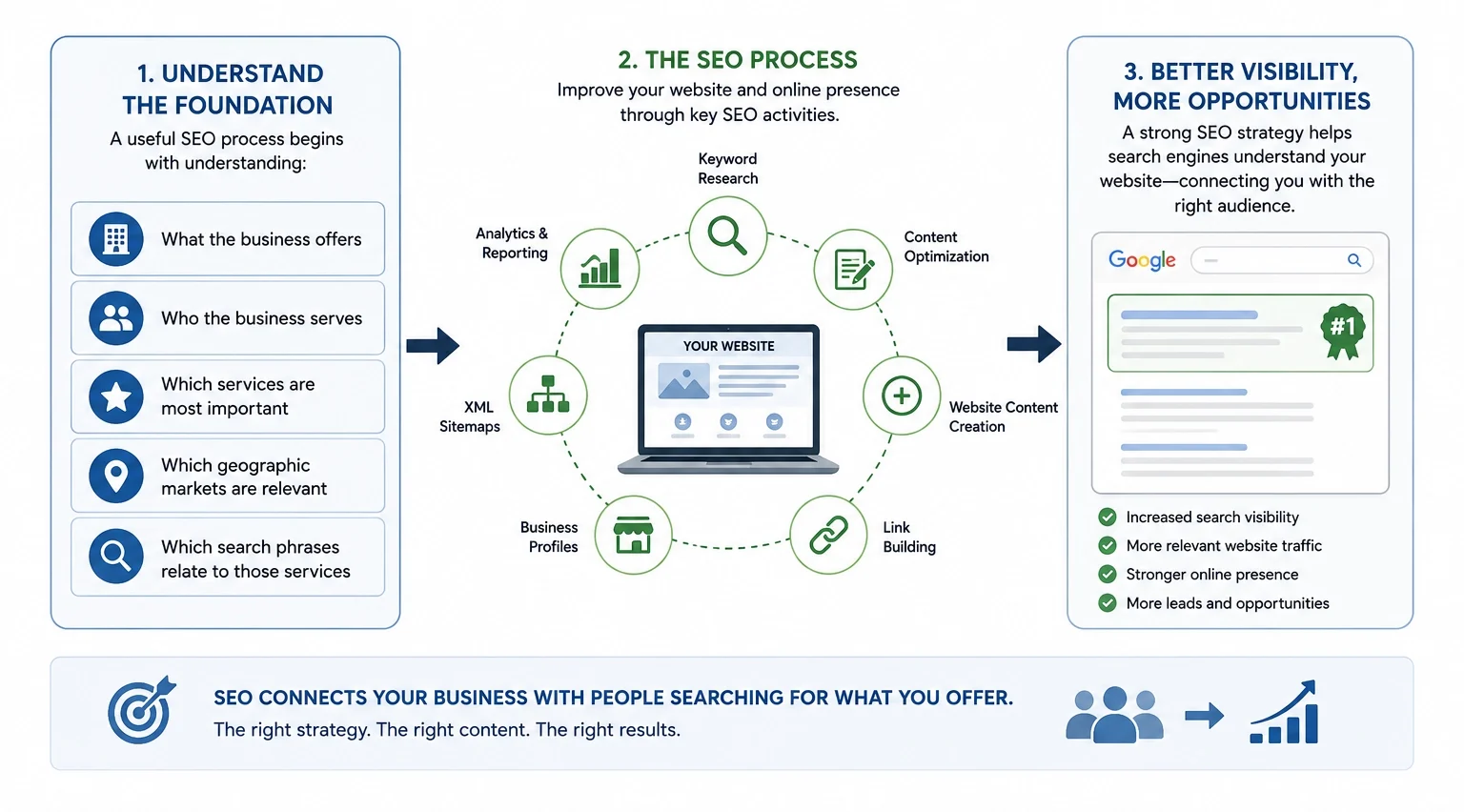
SEO is the process of improving a website and its online presence so search engines can understand its content and connect relevant pages with appropriate searches.
A useful SEO process begins with understanding:
- What the business offers
- Who the business serves
- Which services are most important
- Which geographic markets are relevant
- Which search phrases relate to those services
Once these areas are clear, businesses can improve their websites through activities such as keyword research, content optimization, website content creation, link building, business profiles, XML sitemaps, analytics, and performance recommendations.
Why SEO for Small Business Needs a Focused Approach
Small businesses often have limited time and resources, so SEO works best when priorities are clear. Instead of attempting to target every possible search phrase, a business can focus on its most relevant services, audiences, and geographic markets.
A focused approach can help determine:
- Which pages need improvement
- Which services require dedicated pages
- Where new content is needed
- Which search terms accurately describe the business
- Which geographic areas should be represented
Geographic relevance can be particularly important for companies that serve defined communities. Location-focused content can communicate where a service is available and make a website more relevant to its intended audience.
Keyword Research Creates the Foundation
Keyword research forms the foundation of an effective SEO strategy by helping businesses understand what potential customers are searching for. It can guide the optimization of existing pages and help identify opportunities for new service pages, location-based pages, and content addressing customer questions.
The goal is to use relevant keywords naturally so they improve search visibility without reducing the quality or clarity of the content.
Identify Relevant Search Phrases
- Find search terms that potential customers may use.
- Focus on phrases that accurately relate to the business and its services.
Improve Existing Pages
- Use keyword research to identify opportunities for existing pages.
- Strengthen pages that already address relevant topics.
Plan New Content
- Identify services that may need dedicated pages.
- Find customer questions that deserve useful content.
- Create pages where important information is missing.
Target Relevant Locations
- Determine which locations are important to the business.
- Create location-focused content where it provides useful information.
Use Keywords Naturally
- Avoid repeating keywords unnecessarily.
- Use search phrases only when they accurately describe the page.
- Prioritize useful information for readers.
On-Site Content Optimization
On-site optimization focuses on the content visitors can read and interact with on a website. Pages should clearly explain what the business does, which services it provides, who those services are for, and where relevant services are available.
Good on-page content should be organized around the reader’s needs.
Important Areas to Review
- Clarity: Make the purpose of the page easy to understand.
- Relevance: Ensure the information matches the topic and user intent.
- Keyword alignment: Use relevant search phrases naturally.
- Organization: Use headings and clear sections to make content easier to scan.
- Completeness: Address important information without adding unnecessary content.
Before creating additional pages, businesses should review their existing content to determine whether current pages can be improved.
Non-Visible Content Optimization
Some SEO elements are not part of the main visible copy but still provide information about a webpage. These can include META tags, page titles, alt tags, and other relevant HTML elements.
These elements can provide additional context around a page and make titles and supporting information more descriptive.
| Element | Purpose |
| Page titles | Describe the main subject of a page |
| META information | Provide supporting information about the page |
| Alt tags | Provide information about images |
| HTML elements | Add relevant structure and context |
These elements should accurately represent the page rather than being used to insert unrelated or repetitive search phrases.
Creating Content Where Gaps Exist
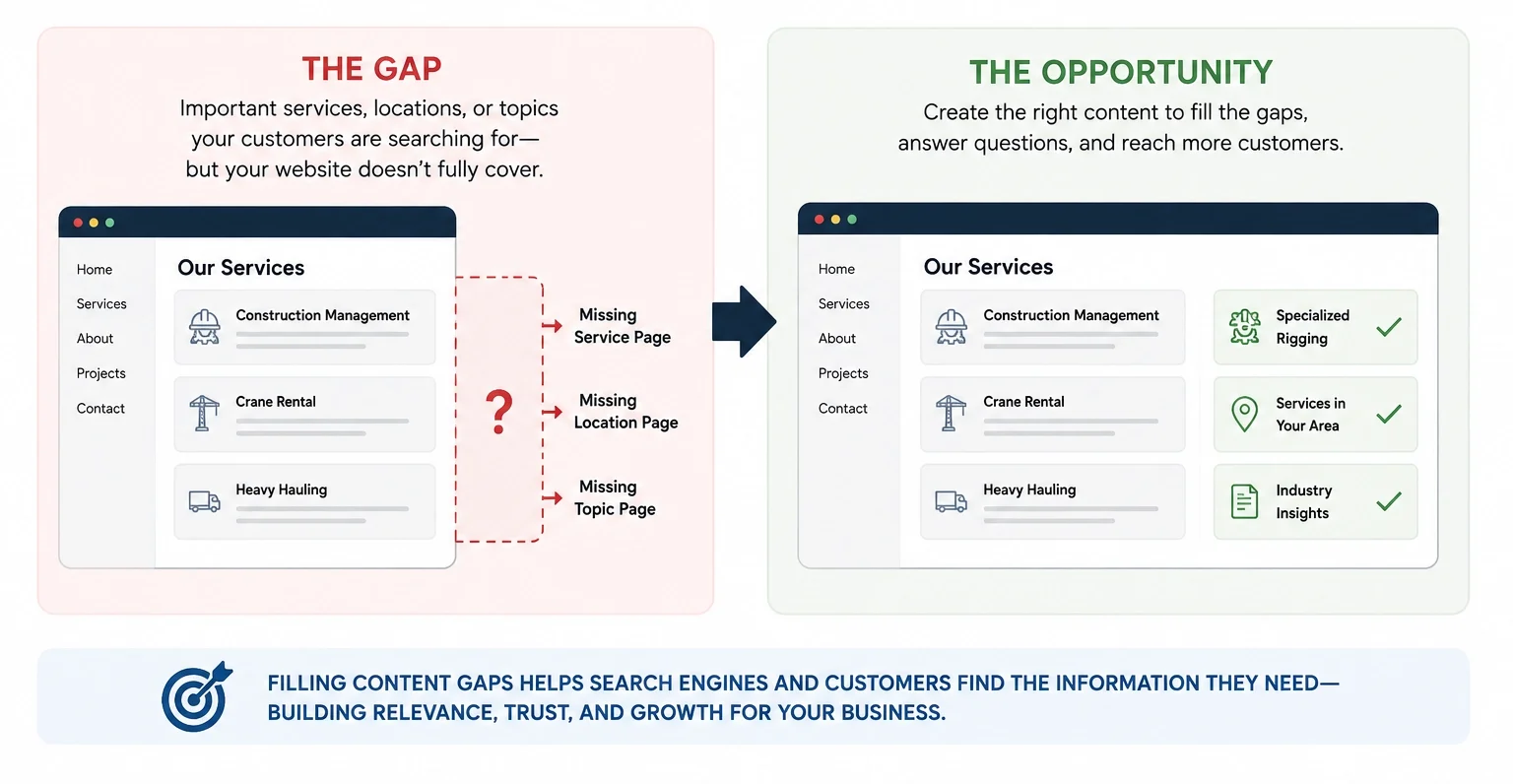
A website may lack pages for every important service, community, or relevant keyword. New pages can address these gaps when an important topic needs more explanation or a geographic market needs dedicated information.
Each new page should have a clear purpose and fit naturally within the website structure.
New Content Can Help When:
- An important service is not adequately explained.
- A relevant location needs dedicated information.
- Customers have questions that existing pages do not answer.
- An important topic is missing from the website.
Creating content should be based on actual information needs rather than simply increasing the number of pages.
Geographic Relevance and Local SEO
Local SEO can be important for businesses that serve customers in specific areas. Geographic relevance can help communicate where a business operates and where its services are available.
Useful location-focused content should provide more than repeated place names. It can explain:
- Services available in the area
- Communities served
- Information relevant to local customers
- Where the business operates
Local SEO can also extend beyond the website through business profiles and local listings.
Business Profiles and Online Presence
Business profiles can support a business’s visibility outside its website. Important information should remain accurate and consistent across relevant online platforms.
Information to Keep Consistent
- Business name
- Address
- Phone number
- Website
- Service details
- Geographic information
A well-maintained profile can complement website content and reinforce geographic relevance. The goal is to make it easier for customers to understand who the business is, what it offers, and where it operates.
Website Structure, Sitemaps, and Crawling
A clear website structure helps users move between pages and helps search engines understand how content is organized.
An XML sitemap provides information about pages available on a website and can support crawling and discovery.
A Practical Website Structure Should:
- Organize services logically.
- Connect supporting content with relevant pages.
- Make important pages easy to find.
- Help visitors move through the website without unnecessary effort.
- Make relationships between different pieces of content clear.
A well-organized structure can also make it easier to identify which pages are most important.
Links and Online Authority
Link building can form another part of an SEO strategy. Links from relevant websites can contribute to a business’s online identity and help generate website visits.
Quality and relevance are more important than simply collecting a large number of links.
Potential Link Sources
- Relevant directories
- Industry resources
- Organizations
- Business partners
- Other appropriate websites
The focus should be on developing a credible online presence rather than link volume alone. Links should make sense for the business, its audience, industry, or geographic market.
Website Performance and User Experience
SEO and website performance are closely connected with the overall visitor experience. A website that loads efficiently, works across devices, and is easy to navigate provides a stronger foundation for visitors.
Website speed optimization can focus on improving loading performance, reducing unnecessary delays, and supporting a smoother experience. Web development can also address functionality, security, mobile optimization, and compatibility across devices and browsers.
A visually appealing website is useful, but it should also function effectively. Clear navigation, organized content, mobile usability, and performance all contribute to a website that visitors can use comfortably.
Measuring SEO Performance
- Monitor website traffic: Use analytics to understand traffic levels and identify areas of strength or weakness.
- Track search performance: Review how your pages appear in search results and identify opportunities for improvement.
- Track keyword rankings: Monitor relevant keywords over time to understand changes in search visibility.
- Review landing pages: Identify which pages attract visitors and evaluate their performance.
- Monitor website changes: Compare performance before and after making SEO or website changes.
- Look beyond rankings: Consider traffic, search performance, landing pages, and other relevant data instead of focusing on a single metric.
- Use data to prioritize improvements: Let performance data guide which SEO improvements should receive attention next.
Why SEO Strategy Needs Ongoing Work
SEO strategy should be treated as an ongoing process rather than a single website task. Search conditions can change, competitors can publish new content, websites can be updated, and search engines can adjust how they evaluate and display results.
Ongoing SEO can therefore include reviewing keyword performance, improving existing content, creating relevant pages, maintaining business profiles, developing appropriate links, monitoring website performance, and making technical or design recommendations when needed.
A continued process also allows a business to learn from its own website data. Instead of making every decision at once, improvements can be prioritized according to performance and business needs.
Common SEO Mistakes Small Businesses Can Avoid
- Targeting too many keywords: Focus on relevant keywords instead of trying to target too many at once.
- Repeating phrases unnaturally: Avoid keyword stuffing and use keywords naturally within the content.
- Overlooking existing pages: Review and improve existing content before creating new pages.
- Ignoring local relevance: Include location-specific information when it is relevant to the business and its audience.
- Focusing only on rankings: Consider traffic quality, relevant visitors, user experience, and business outcomes alongside rankings.
- Creating unnecessary pages: Prioritize improving important existing pages instead of assuming every SEO improvement requires a new page.
- Losing focus: A targeted SEO strategy helps businesses spend more time improving the pages and information that matter most.
A Practical SEO Process for Small Businesses
Start with a website review, then define the most important services and geographic markets. Research relevant search phrases and map them to existing or planned pages. Improve current pages and create new content where gaps exist.
Review business profiles and relevant directories, develop appropriate link opportunities, and maintain the XML sitemap. Use analytics and search performance information to evaluate rankings, traffic, landing pages, and other useful signals.
Finally, continue refining the website so research, content, technical work, measurement, and improvement operate as one process.
Putting SEO Into Practice
A sustainable approach to SEO for small business begins with relevance. The website should clearly explain its services, communicate its market, provide information, and give search engines enough context to understand its pages.
From keyword research and content optimization to local relevance, business profiles, website structure, link building, performance, and analytics, each element can support the larger goal of making a website easier to find and use.
The process is strongest when these activities are connected rather than handled in isolation. Businesses can review what they already have, identify gaps, prioritize improvements, measure results, and continue refining the website as needs change.
For businesses looking for a combination of web, search, and digital expertise, RDC Design Group brings together web design, web development, website performance optimization, Internet marketing, branding, and Search Engine Optimization. Its website describes SEO work that includes keyword research, visible and non-visible content optimization, geographic content strategies, local SEO with Google Business Profiles, business profiles, XML sitemaps, analytics, webmaster tools, ranking reports, and ongoing SEO services. It also presents SEO as continuing work that can be adjusted as search performance changes. This reflects a broader approach in which content, technical elements, local relevance, measurement, and website experience are considered together. For a small business, that type of connected process can make SEO easier to organize and keep focused on useful website improvements. Rather than treating search optimization as a checklist completed once, businesses can use ongoing review to identify opportunities, address gaps, and keep important website information useful and accessible.
Frequently Asked Questions
What is SEO for small business?
SEO for small business is the process of improving a small business website and online presence so relevant people can find useful information through search engines.
It can include:
- Keyword research
- Content optimization
- Geographic content
- Business profiles
- Link building
- XML sitemaps
- Analytics
- Ongoing improvements
How does small business SEO help a website?
Small business SEO can improve how clearly a website communicates its services, locations, and topics to search engines and visitors.
The work can include improving existing pages, creating useful new content, and strengthening technical and off-site elements.
What are SEO services?
SEO services are activities used to improve a website’s search visibility and online presence.
Depending on the business, these may include keyword research, on-page SEO and non-visible content optimization, website content creation, link building, business profiles, XML sitemaps, analytics, ranking reports, and ongoing SEO work.
Why is an SEO strategy important?
An SEO strategy gives a business a structured way to prioritize search-related work. It can connect keyword research with website pages, geographic markets, content creation, technical improvements, measurement, and ongoing optimization.
Can SEO increase organic traffic?
SEO can support greater organic traffic by improving a website’s relevance, visibility, content, and technical foundation.
Traffic should be evaluated alongside the quality and relevance of visitors rather than treated as the only measure of success.
How do Google rankings relate to SEO?
Google rankings indicate where pages appear for particular searches. SEO can work to improve a website’s relevance, content, technical quality, and online presence.
However, rankings can change and should be monitored alongside traffic and other performance information.
What is local SEO?
Local SEO focuses on improving visibility for searches connected with a specific geographic area.
It can include:
- Geographic content
- Local business profiles
- Accurate business information
- Other activities that communicate where a business operates
How important is website speed for SEO?
Website speed contributes to the overall user experience and can also relate to search visibility.
Improving loading performance, mobile usability, navigation, and functionality can create a stronger website foundation.
What should a small business monitor after SEO work?
A business can monitor:
- Website traffic
- Search performance
- Keyword rankings
- Landing pages
- Website changes
These signals can help identify what is working and where improvements may be useful.
Can existing pages be optimized instead of creating new ones?
Yes. Existing pages can often be improved through clearer content, relevant keyword targeting, page titles, META information, alt tags, better organization, and other appropriate optimizations.
New pages are most useful when an important topic, service, or location is not adequately represented.